Mercatale Val di Pesa

Mercatale Val di Pesa in the comune of San Casciano Val di Pesa

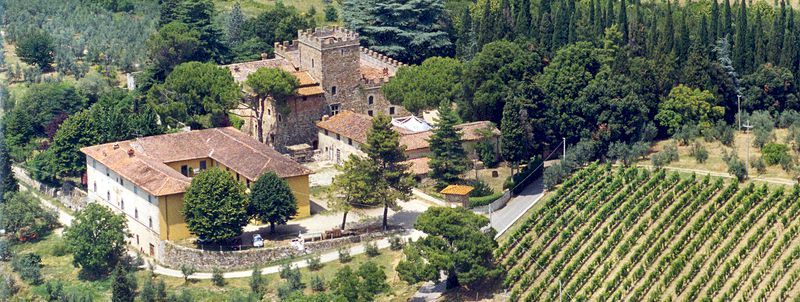
Castello il Palagio at Mercatale

Castello il Palagio

Click here for a
brief history of Castello Il Palagio near Mercatale

The town of Mercatale di Val di Pesa lies within the Chianti Classico wine zone at the top of the hills that divide the Pesa valley from the Greve valley. The first documents to mention it date back to 1237 when Messer Marzoppo della Tosa, the Podestà of Montecampolese, ordered a public square to be built in which the local market could be held. Especially during religious holidays, in fact, fairs or meetings used to be held for the purpose of bargaining and selling food, cattle, everyday objects. They were generally held outside the walls of ancient castles, in open and easily accessible places. These places used to be called "Mercatali", a word that has remained for various towns in Tuscany. A village called "Beccamorto" and, later, Mercatale del Beccamorto, was born around this square (recently repaved in cotto). The Strozzi family built their palace in this square. Today it is called Villa Nunzi and is one of the oldest and most beautiful buildings in the town that that developed over time with its enviable buildings in the prestigious area of Chianti in the borough of San Casciano in Val di Pesa. Alongside the villa, there is the Church of St Mary at Mercatale, inside which interesting artistic works can be found. These include a precious copper Astylar Cross with engravings of the symbols of the four Evangelists and two precious sculpted altars with good quality eighteenth century altar-pieces.

Click here for a map of the location of Mercatale in the Chianti Classico zone


Castle Gabbiano

Via di Gabbiano, 22 - 50024 Mercatale Val di Pesa (FI)

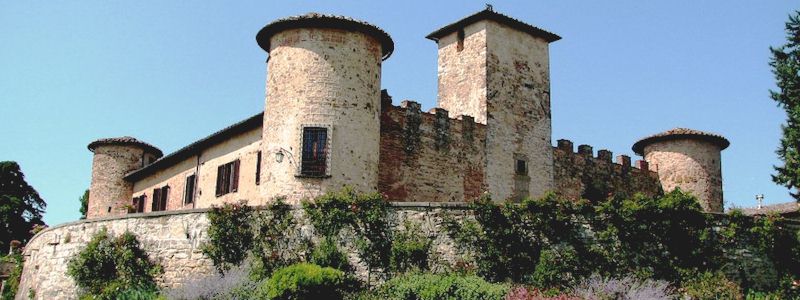
Early records indicate that the construction of a defence tower began at Castello di Gabbiano in 1100 AD. The tower was built to protect one of the most important trade routes between Florence and Siena. About two decades later, in 1124, a wine storage cellar, with vaulted ceilings, was added to the site. The existence of the wine cellar is proof that wine was being made at the estate from the beginning of its history.

The estate's original owners, the Bardis, were one of the wealthiest Florentine banking families. In the late 1200's, the family expanded the fortress, building walls on either side of the original tower. The new walls were crenellated in the
Guelph architectural style of that time. In the fifteenth century Gabbiano passed from the Bardi family into the hands of another prestigious Florentine Family, the Soderinis. It was during the Soderini era that the “casa padronale” was converted into a farm house and into a structure very similar to the one that stands today. We know this from the “portata catastale”, a hand-written document by Pier Soderini’s father, Tommaso, dated 1464. During the course of the century, the Soderini family made continual developments to the estate. This is evident by the walls of the castello, where we can see the different phrases of growth over time. The complex was thus transformed into a large square construction that constituted a private fortress with four round towers. These towers are an example of the strong French architectural influence of the time and remain a feature of the castle today.

In 1506, when the township of Bologna urged the rulers of Florence to send Michelangelo to Bologna, it was Castello di Gabbiano's Pier Soderini who wrote a letter of introduction for Michelangelo. It said: "The bearer of this letter is the sculptor Michelangelo. We place him at your disposal to serve His Holiness, our lord. We bear witness that he is a very talented young man and second to none as regards his art in Italy and maybe in the whole world. It is not possible for us to recommend him warmly enough; he is so good natured that, with gentleness and friendship, you can obtain all you want from him. You must treat him lovingly and kindly and he will make things that will amaze everyone who will see them." At the end of November 1506, with Pier's letter in hand, Michelangelo headed to
Bologna to make a bronze statue of Pope Julius II.

Another friend of Pier Soderini was
Amerigo Vespucci who was born in nearby Montefioralle. When Amerigo returned from his travels in America, the first letter he wrote was to his friend Pier. Pier and Amerigo had attended school together at the cloister of St. Marco, where Amerigo's Uncle (Father Giorgio Antonio Vespucci) had been their teacher. From then on, the two had remained good friends.

Sometime in the 16th century, when the Soderinis opposed the powerful Medici family, they were banished from Florence and forced to abandon the castle. It remained unoccupied for a very long time. In the 17th century, the Soderini’s returned from forced exile, and restored new life to the castle once again. During the 19th century the Castello was owned by a number of families who instigated various restoration projects. However the integrity of the original architecture has been retained.

.

Villa S.Andrea
Your vacation accommodation near San Casciano and Florence

Villa S.Andrea is a working Chianti Classico winery covering 1300 acres near Mercatale Val di Pesa. We offer Bed & Breakfast rooms and vacation apartments ranging from single rooms through apartments for up to 8 persons and a villa for 12 persons. Cellar visits and wine tasting are available, and splendid walking and bicycling possibilities abound. More about Villa S.Andrea.


Pieve di Santo Stefano di Campòli

Questa pagina è momentaneamente in allestimento. Vi piacerebbe qui la vostra pubblicità? Vedete i dettagli dei nostri progetti per le pagine internet. Per ottenere un'idea come sarà collocata la pagina e per vedere qualche esempi di pubblicità, visitate i nostri siti di Greve in Chianti e Panzano. Durante il periodo di allestimento, la vostra pubblicità sarà inserita nel nostro sito www.bella-toscana.com, con l'immediato compimento dei vostro pseudonimo e-mail. Quando la vostra pubblicità sarà trasferita alla posizione permanente di questo sito, continuerà ad essere registrata nel sito www.bella-toscana.com senza spese supplementari con un collegamento ("link") alla vostra home page nel sito www.mercatale.net


Web sites, database development and java programming ammonet